Research Direction
Chemistry at interfaces is shaped by evolving structures and environments that idealized models often overlook. The Bunting group will develop models that capture this complexity under experimental conditions, connecting predictions directly with measurements.
Chemistry at interfaces
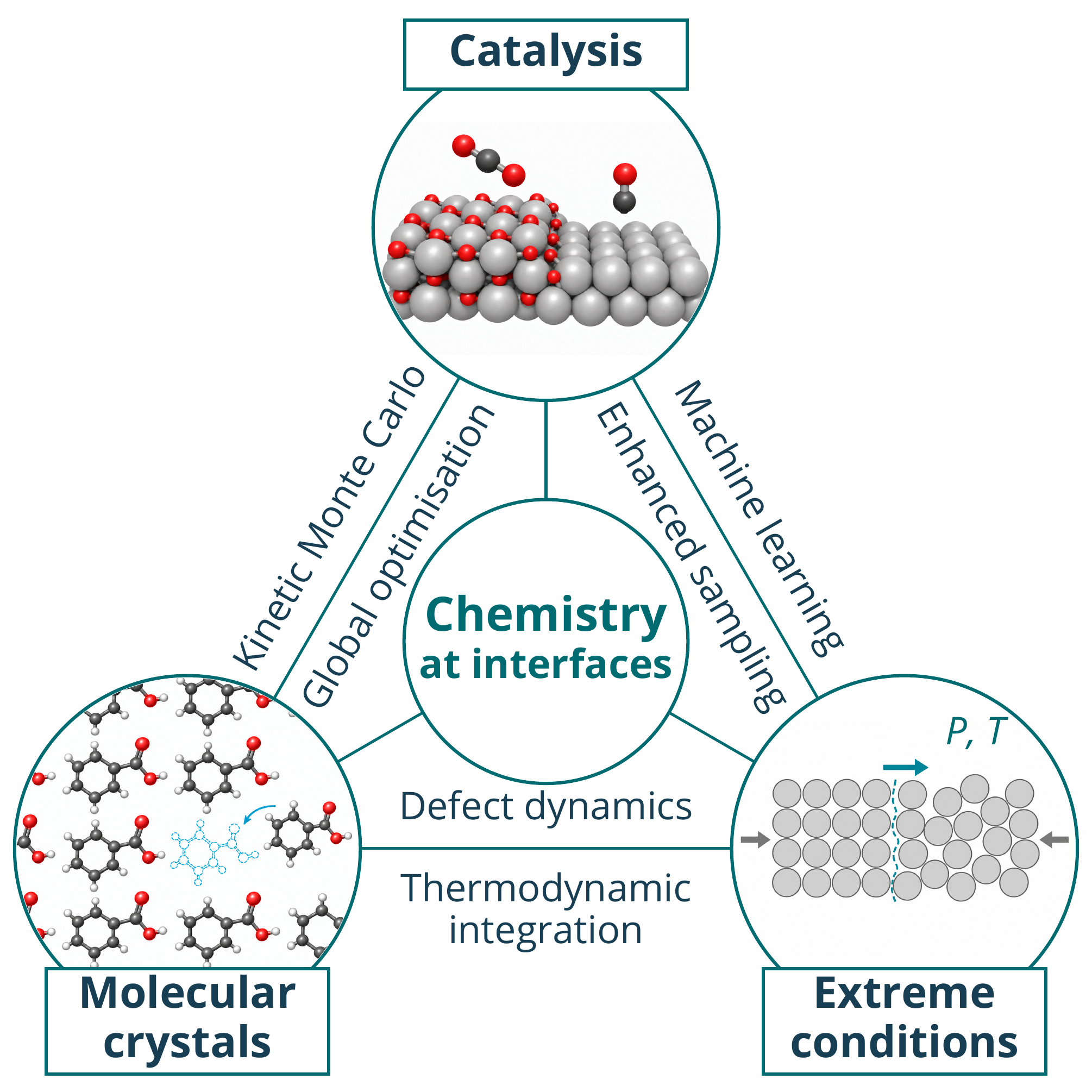
My group will investigate how interfaces evolve and how their changing structure influences chemical reactivity, phase transformations, and the formation of molecular crystals. We will pursue this research across three themes: catalysis; extreme conditions; and molecular crystals. These cross-cutting themes will be tied together through the development of computational methods. We will combine molecular dynamics, free-energy methods, global optimization, machine learning interatomic potentials, and kinetic modeling to achieve physically representative models of evolving interfaces. These models will bridge theory to the experimentally relevant time and length scales to elucidate the mechanisms of structural evolution.
Catalysis
Efficient chemical conversion requires catalysts that are active, selective, and stable under operating conditions. Reaction conditions often reshape interfaces and alter active sites in situ, changing reactivity over time. This evolution changes active-site populations and can limit the accuracy of predictions based on ex situ structures.We will resolve the coupling between surface reactions and restructuring, connecting the creation and loss of active sites to reaction kinetics.This will identify structural motifs that sustain activity, selectivity, and stability, guiding catalyst design for more sustainable chemical production.
Extreme conditions
Chemistry under high pressure and temperature is central to geochemical processes, fusion energy, and space travel. Equilibrium phase stability alone cannot fully predict material behavior during rapid compression. The short timescales make atomic mechanisms difficult to resolve through experiments alone. With experimental collaborators, we will determine how interfaces influence phase transformation mechanisms and pathways during shock compression.This work will inform the synthesis of metastable materials and advance understanding of transformations in extreme environments.
Molecular crystals
Molecular crystals are essential to medicines, radiation detectors, and optical technologies. However, predicting the most stable structures does not establish which polymorph will nucleate and grow.We will combine structure prediction and phase diagram calculations with simulations of nucleation, growth and dissolution to resolve molecular assembly at interfaces.We will determine how growth conditions dictate which polymorph forms and govern defect formation. These insights will support pharmaceutical drug design and the manufacture of optical crystals.